Is Ketosco.com a Keto-Related Website? A Complete Guide
The internet contains thousands of websites covering health, nutrition, fitness, and lifestyle topics. As interest in the ketogenic diet continues, users often search for websites with names that include terms such as keto. One example is ketosco.com, a domain that may raise questions about its purpose and connection to ketogenic nutrition.
The ketogenic diet is generally characterized by very low carbohydrate intake, moderate protein consumption, and a higher proportion of dietary fat. It is used by some people for specific health and dietary goals, although its suitability varies from person to person. But does ketosco.com focus on this subject, or does its name represent something else?
This article examines the question, explains how to assess a website’s actual focus, and discusses what visitors should consider before relying on online health information.
Verification note: Search results may contain information about similarly named domains. The exact ketosco.com website should be checked directly before making definitive claims about its current content, ownership, or services.
1. Understanding the Meaning of “Keto”
Before examining whether ketosco.com is related to the keto diet, it helps to understand what the term “keto” means.
The ketogenic diet is a dietary approach that significantly reduces carbohydrate intake and emphasizes fat as a major energy source. When carbohydrate availability is sufficiently low, the body can enter a metabolic state called ketosis, in which it produces ketones from fat.
People explore keto for different reasons, including dietary preferences, weight management, and certain medical applications.
However, the presence of the word “keto” in a website name does not automatically indicate that the platform provides nutritional guidance.
Common Keto-Related Topics
A website focused on ketogenic nutrition might cover:
- Keto-friendly recipes
- Low-carbohydrate food choices
- Meal planning
- Ketosis and metabolism
- Nutrition education
- Exercise and lifestyle
- Dietary considerations
- Research about ketogenic diets
Whether ketosco.com offers these topics must be established by reviewing its actual published content.
2. Does the Website Name Confirm Its Purpose?
A domain name is a branding element, not independent evidence of a website’s services.
For example, a website containing the word “keto” could potentially focus on:
| Possible Focus | Description |
|---|---|
| Nutrition Blog | Articles about food and dietary practices |
| Health Website | General wellness and health information |
| Lifestyle Platform | Content covering several lifestyle subjects |
| Business Website | A company or service using “Keto” as part of its name |
| General Blog | Articles across different categories |
These are possible interpretations, not confirmed descriptions of ketosco.com’s business or content.
Visitors should check the About Us page, homepage, category listings, and individual articles to understand the platform’s actual purpose.
3. What Is the Difference Between a Keto Website and a General Blog?
A specialized keto website usually has a consistent focus on ketogenic nutrition or related subjects. A general blog, by contrast, may publish articles across multiple industries and interests.
Understanding this distinction helps readers decide whether a platform is appropriate for their research.
Specialized Keto Website
A dedicated keto platform might provide:
- Detailed meal plans
- Recipes designed around carbohydrate restrictions
- Nutrition explanations
- Information about ketogenic ingredients
- Articles discussing dietary research
- Tools for tracking food intake
The depth and accuracy of these resources should be assessed individually.
General-Interest Blog
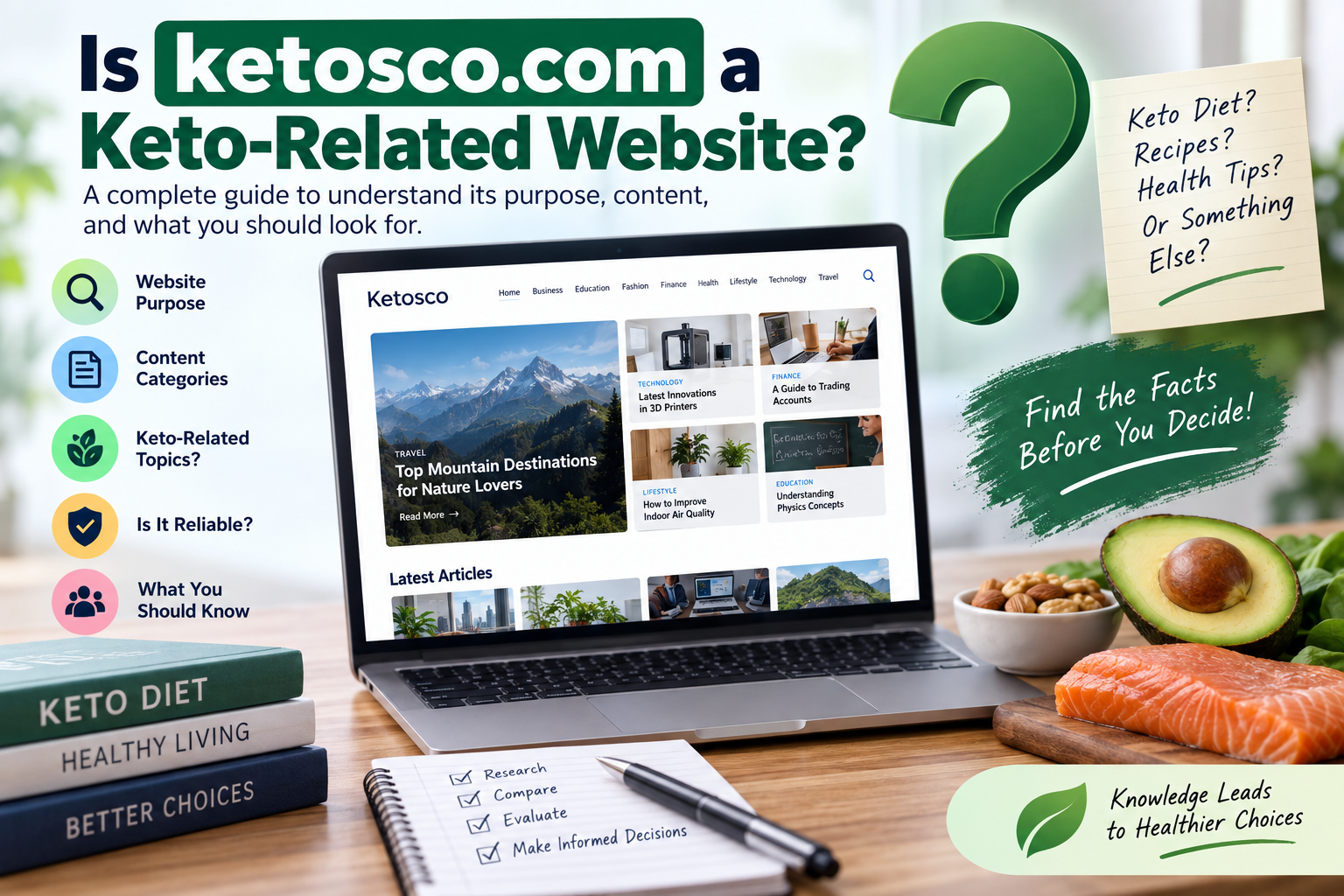
A general blog may publish content on subjects such as:
- Technology
- Business
- Finance
- Lifestyle
- Education
- Health
- Travel
A general-interest website can still publish keto-related articles without being a specialized ketogenic resource.
The key difference is the website’s demonstrated content focus, not simply the domain name.
4. How to Check Whether Ketosco.com Publishes Keto Content
If you want to determine whether ketosco.com is connected to ketogenic nutrition, follow a practical review process.
Step 1: Visit the Homepage
Start by reviewing the homepage. Look for the website’s title, description, navigation menu, and featured articles.
Ask yourself:
- Does the homepage mention keto nutrition?
- Are there food or diet-related categories?
- Does the platform promote health-related services?
- Is the website focused on a particular subject?
The homepage can provide useful context, but it may not show every article published on a website.
Step 2: Review the Categories
Look for categories related to:
- Keto diet
- Low-carb nutrition
- Healthy eating
- Recipes
- Weight management
- Fitness and wellness
The presence of a health category does not necessarily mean that the website specializes in keto.
Step 3: Search for Relevant Articles
Use the website’s internal search function, if available. You can also search Google using queries such as:
site:ketosco.com ketosite:ketosco.com ketogenic dietsite:ketosco.com low carb
These searches can help identify indexed content, although search results may be incomplete and should not be treated as proof that all content is current.
Step 4: Read the About Us Page
The About Us page may explain the website’s mission, editorial focus, and intended audience.
Compare the stated purpose with the content actually published on the website.
5. Why Are People Interested in Keto-Related Websites?
The ketogenic diet has attracted attention from people interested in nutrition and lifestyle changes. As a result, users may search for websites that provide educational resources, recipes, or dietary information.
Some common reasons people explore keto websites include:
Learning About Low-Carbohydrate Eating
People who want to reduce their carbohydrate intake may look for explanations of food choices and meal planning.
Finding Recipe Ideas
Keto-focused websites often appeal to users seeking meal inspiration, including low-carbohydrate breakfast, lunch, and dinner options.
Understanding Ketosis
Readers may want to understand how the body uses ketones and how dietary changes influence metabolism.
Exploring Health Information
Some users search for information about the potential benefits and limitations of ketogenic diets.
Health-related content should be evaluated carefully, particularly when it discusses medical conditions or promises specific outcomes.
6. What Should You Check Before Trusting Keto-Related Content?
If ketosco.com publishes health or nutrition articles, readers should assess the quality of the information before relying on it.
Author Expertise
Check whether articles identify their authors and explain relevant qualifications.
A writer’s background can provide context, although credentials should be independently verified when important health decisions are involved.
Scientific References
Look for references to credible sources, such as:
- Peer-reviewed research
- Government health organizations
- Recognized medical institutions
- Professional nutrition organizations
A citation is useful when it accurately supports the claim being made.
Balanced Information
Reliable health education should acknowledge relevant limitations and uncertainty.
Be cautious of content that presents a diet as a guaranteed solution for every health concern.
Publication and Update Dates
Check when an article was published or last updated. Nutrition research and recommendations can change, and older information may require additional verification.
7. Potential Benefits and Limitations of Keto Information
The value of a keto-related website depends partly on the quality and accuracy of the information it provides.
Potential Benefits
A well-researched nutrition website may help readers:
- Understand basic dietary concepts.
- Explore meal-planning ideas.
- Learn about carbohydrate content.
- Discover relevant research.
- Prepare questions for a healthcare professional.
These benefits depend on the reliability of the published information.
Important Limitations
Keto diets are not appropriate for everyone, and individual nutritional needs vary.
People with certain medical conditions, those taking medication that affects blood glucose, and individuals with specific dietary requirements should seek professional medical guidance before making substantial dietary changes.
The ketogenic diet also has potential drawbacks, including difficulty maintaining restrictive eating patterns and possible nutrient imbalances if meals are not planned carefully.
A website article should not replace individualized medical advice.
8. Is Ketosco.com a Reliable Source of Keto Information?
Reliability should be assessed through evidence rather than the website’s name or appearance.
When evaluating ketosco.com as a possible health information source, consider the following:
| Evaluation Factor | Why It Matters |
|---|---|
| Author Information | Helps readers understand who created the content |
| Sources | Allows important claims to be checked |
| Editorial Standards | Provides insight into content quality |
| Transparency | Helps explain the website’s purpose and ownership |
| Medical Accuracy | Important for health-related decisions |
| Content Updates | Helps readers identify current information |
At the time of this review, I cannot independently confirm the full contents of ketosco.com through the available website access. Therefore, I cannot establish its editorial standards, authorship, or reliability as a keto information source.
9. Ketosco.com and Other Keto Websites
There are established websites that explicitly identify themselves with ketogenic nutrition, but similarly named platforms should not be confused with one another.
For example, Ketosource describes its focus as ketogenic and fasting science, while KetoShop offers low-carbohydrate and ketogenic products. These are separate websites and do not establish any connection with ketosco.com.
| Website | Publicly Described Focus |
|---|---|
| Ketosco.com | Requires direct verification |
| Ketosource | Keto and fasting science, tools, and products |
| KetoShop | Low-carb and ketogenic products |
| KetoCycle | Ketogenic diet planning and app-based resources |
This comparison is intended to distinguish publicly described website purposes. It does not establish any relationship between the platforms or assess their overall quality.
10. Common Mistakes When Evaluating a Website
Visitors sometimes make assumptions about online platforms based on limited information.
Avoid these common mistakes when researching ketosco.com.
Mistake 1: Assuming the Domain Name Is a Guarantee
The presence of “keto” in a domain name does not prove that the website specializes in ketogenic nutrition.
Mistake 2: Trusting Every Health Claim
Health-related statements should be evaluated against credible evidence.
Mistake 3: Confusing Similar Domains
A domain with a similar name may belong to an entirely different website.
Always verify the exact domain before relying on information or submitting personal details.
Mistake 4: Ignoring Website Transparency
Check for information about the website’s ownership, contact details, and editorial policies when available.
Mistake 5: Making Dietary Changes Without Guidance
People with medical conditions or special nutritional needs should consult qualified healthcare professionals before making major dietary changes.
11. How to Use Keto-Related Online Information Responsibly
Online nutrition content can be useful for general education, but readers should approach it thoughtfully.
Here are some practical recommendations:
Compare information: Review claims across multiple credible sources.
Check the date: Look for publication and update information.
Understand context: Consider whether an article discusses general nutrition or a specific medical situation.
Avoid guaranteed promises: No website should be assumed to guarantee a particular health outcome.
Seek professional guidance: Consult a qualified healthcare professional when dietary decisions may affect your health.
These steps can help users make better-informed decisions while exploring nutrition information online.
12. Frequently Asked Questions
1. Is ketosco.com a keto-related website?
The domain name suggests a possible connection to keto, but its actual purpose and content focus need to be verified directly. The name alone does not establish that it is a ketogenic nutrition website.
2. Does ketosco.com provide keto diet plans?
There is insufficient verified information to confirm whether ketosco.com provides dedicated keto meal plans or dietary programs. Check its current website content for specific offerings.
3. Can I trust health information published on ketosco.com?
Assess the authorship, supporting references, editorial transparency, and accuracy of individual articles. Do not rely on unverified health claims for medical decisions.
4. What is a ketogenic diet?
A ketogenic diet is a low-carbohydrate dietary approach that encourages the body to use ketones as an energy source. Its suitability depends on individual circumstances.
5. How can I verify a website’s purpose?
Review its homepage, About Us page, categories, published articles, and contact information. Confirm that you are examining the exact domain you intend to research.
Conclusion
The question “Is ketosco.com a keto-related website?” cannot be answered conclusively from the domain name alone. Although “keto” is commonly associated with ketogenic nutrition, the website’s actual purpose must be established through its content, services, and publicly available information.
Visitors interested in keto should look for clear explanations, credible references, transparent authorship, and accurate health information. They should also distinguish between specialized nutrition websites and general-interest blogs that may occasionally publish diet-related articles.
Before relying on ketosco.com for dietary guidance, verify its current content and evaluate whether the information meets your needs. A careful approach helps ensure that online research supports informed decisions without replacing professional medical advice.